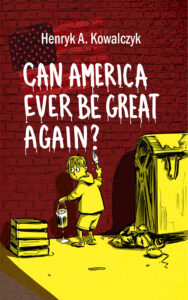
Many tell us what to think. I ask my readers to be skeptical. Question me and others.
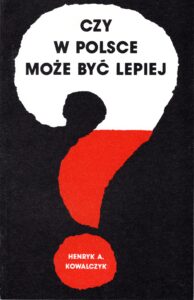
“Could it be better in Poland?” is a book I wrote in 1980 in Poland. I finished writing it barely days before the strikes erupted in August that year, leading to the formation of the Solidarity movement.
As an intern in 1972, I joined the team of the best political writers of that time in Poland. I wrote a memoir article about that experience: What did I learn from the world’s best editor? In the fall of 1973, apparatchiks decided that the team was too good for their tastes and fired the key writers.
I could not find permanent employment as a political writer, but I managed to publish as a freelancer. My article claiming that the educated Poles were becoming neither lofty nor stupid, published in POLITYKA, the major political weekly in Poland, became an essay of a year in 1977. But as the economic situation deteriorated and social tension rose, my ability to publish diminished. Sensing the next crisis coming, I decided to write a book. Mostly because I witnessed bloody political riots in Gdańsk in 1970 and was concerned that a new crisis might be much more tragic.
I had difficulty finding a publisher, but in 1981 Wydawnictwo Literackie, one of the most prominent publishing houses in Poland, bought it. They had it ready for print when martial law was called in December of 1981. So, the publication of my book was blocked. A person in a leadership position at Wydawnictwo Literackie decided to use her contacts to publish the book. She approached top politicians asking for help. A former editor at POLITYKA, Jerzy Urban, who strongly supported my writings, was at that time a government’s press secretary. He responded that, being familiar with my writings, he knew his response would be negative without reading.
Wiesław Górnicki, a former journalist in the newspaper where I had my internship in 1972, took a bait. At that time, he was one of the top political advisors to General Wojciech Jaruzelski, the chief ruler of Poland. Interestingly, two years earlier, we met at a social event, where, sipping alcoholic beverages, we had an extensive conversation about political writing and politics in general. He declared himself to be an admirer of my political writing.
It did not help. According to the leading letter to his review, which he, in writing, allowed the publishing house to forward to me, he devoted a big part of his summer vacation in 1982 to reading my book and writing a 30-page-long review. Obviously, he was against publishing my book, and in one instance commented that my continuing that kind of writing could put my safety in Poland in danger.
The only thing I could do was to write an equally long riposte and send an original to the publishing house, and a copy to Wiesław Górnicki. After receiving it, he called the publishing house, very indignant. In my take, he was one of those people deeply believing in socialism as a good and noble concept. So, playing this card, I called his office about a year later and asked for a meeting. He accepted.
He opened a conversation offering me help with whatever personal need I might have. It appears that most people who asked for a meeting needed some help. To his surprise, I was doing fine and did not need any help. However, after about two years under martial law, the country was doing worse than before. So, I insisted that books like mine, or a newer version of it, could be a way to overcome the obstacles. His instinct as a debater kicked in, and he opened up a little, sharing with me his assessment of the situation in Poland at that time. Besides that, I was pleasantly surprised that in his mind he was still struggling with my reasoning in the book and in my riposte. I pressed that something needs to be done. I could not hide my shock when he told me that the hard-headed people in the Polish political elite could not accept any reform. After all, I was talking with the top advisor to the top Polish leader. He noticed my reaction to his candor, realizing that he might say too much, so he wound up the meeting.
On my way back, despite getting nothing, I felt satisfied because I saw that he could not dismiss the arguments from my writings. But most of all, I realized that one of the leading Polish socialists lost faith that socialism could ever work in Poland. On the other hand, I saw political tensions growing, and the possibility of a bloody confrontation.
In 1985, fate landed me in Chicago. When an opportunity showed up, I extended my stay and eventually made it permanent. In 1988, when I was in Chicago, I self-published my book “Could it be better in Poland?”, together with Górnicki’s review and my reply to it. In 1989, the socialist government collapsed in Poland, triggering the fall of the Soviet Union two years later.
It was one of the major political changes in the history of humankind that happened peacefully. To some degree, many things happened as I speculated about that possibility in my book written in 1980. Can a political writer ask for more?