
 Many tell us what to think. I ask my readers to be skeptical. Question me and others.

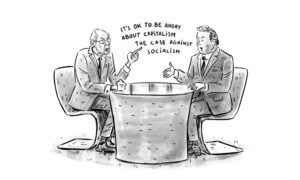
In mid-October 2026, I watched John Stossel’s interview with Steve Forbes on socialism, innovation, and America. Since its July 28 release on YouTube, it already had more than 200 thousand views and more than 600 comments. I read more than 100 randomly selected comments and found only one critical post, pointing out that billionaires also get free stuff from the government.
That commenter went silent after six other participants scolded them with different variations of the same message: “You’re dishonest, or you don’t understand basic things.” All other comments enthusiastically applauded Steve Forbes for clearly presenting the benefits of the free market and capitalism. I agree that Steve Forbes presented his cause brilliantly. Still, he did not answer John Stossel’s opening question: Why are socialists winning?
Older readers do not need an introduction to either Steve Forbes or John Stossel. Younger readers might recognize Steve Forbes as a Chairman and Editor-in-Chief of Forbes magazine. Still, they might not remember John Stossel and his once-famous Give Me a Break segment on the 20/20 show. His specialty was scrutinizing commonly held opinions and showing that facts and logic prove otherwise. In recent decades, most Americans sought solutions to our problems by giving our government greater powers to manage our public affairs. No wonder, most of Stossel’s political segments pointed out the opposite – that, for greater prosperity, we need fewer regulations and less welfare.
In other words, John Stossel emerged as the supporter of free-market capitalism and critic of ideas and policies associated with socialism. He still has devoted followers, but the masses turned toward socialism. In the opening of the interview with Steve Forbes, John Stossel acknowledged: “I’ve failed! For years, I’ve made the case for free markets. Yet now socialists WIN elections.” As the chief of a major business magazine, Steve Forbes, by definition, stands against socialist views. When Stossel asked him directly why socialists are winning, he didn’t answer straightforwardly; instead, he reiterated, over and over again, his arguments for free markets and capitalism in an optimistic tone.
I can agree with his arguments but would stick with Stossel’s pessimism. Forbes magazine has failed as well. With the transition from print to digital, it is hard to evaluate how the readership changed. Millions of clicks do not tell us how much people read Forbes online. Almost everyone checked the list of the 400 wealthiest Americans at least once. But that list began in 1982, with precursors reaching back to Forbes’s first year in 1918. In recent years, Forbes added 30 Under 30, the Midas List, and a few other reporting initiatives that gained popularity in business circles, but do nothing to convince Americans that capitalism is better than socialism.
Pro-socialist candidates win elections, and no one should be surprised. Recent opinion polls show that, depending on the polling, anywhere between 52% and 57% of young Americans, 18-34, support socialism. It is only about one-third of people 55 and older, but that is still surprisingly high. Steve Forbes can make good arguments, but as I saw in the comments on the video, only already-convinced Americans cherish them. And they chase away the skeptics. In other words, I doubt Forbes’ brilliant reasoning in the video convinced even one socialist that capitalism and free markets are better. In short, Steve Forbes is in big denial. Reality does not support his optimism that his rational arguments will eventually prevail in American politics.
This situation literally begged John Stossel to challenge Steve Forbes with his signature Give Me a Break. Do not pull wool over my eyes that capitalism and free markets are better; I already know that. Face the reality: Americans do not buy that. So let us leave the ivory tower of lofty ideas, go down to the street, and talk about what matters: why are our opponents winning? John Stossel did not do it. As a result, existing supporters will praise this interview, and opponents will ignore it. And life goes on.
In 1956, Ludwig von Mises wrote a pamphlet, “The Anti-Capitalistic Mentality,” which explains many aspects of the popularity of socialist ideas. I bet that both Stossel and Forbes, as well as their accolades, are familiar with this publication, which – kindly speaking – presents opponents of capitalism as poorly informed. Opponents see that pamphlet as highly offensive, so there is not much common ground for conversation here.
I found a less antagonistic approach in Alexis de Tocqueville’s classic “Democracy in America.” He extensively elaborates on a dichotomy between freedom and equality. Most people understand that they need to be free to be equal. But things get complicated when free people do not advance equally. It is human to worry that those who become wealthy, elected to office, or gain popularity might abuse their influence, acquiring even more by harming others. In a democratic society, people ask their government agencies to protect them from the undue influence of more powerful individuals.
Unfortunately, laws must apply equally to all. This means that whatever restraints are implemented to protect the less fortunate from the abuses by the affluent also restrict everyone’s freedoms, including the less affluent’s ability to advance. So, it is easy to overdo it. Then, as we have it now in the United States, the more the government does to protect the underprivileged, the wealth disparities do not disappear; they grow. Everyone sees those wealth disparities growing; few understand why.
Ironically, it is nothing new either. Almost 200 years ago, de Tocqueville explained that as well. People in prosperous nations are busy taking care of their daily affairs. They do not have the time or patience to study the mechanics of social and economic processes. They fall easily for simple explanations. Then, they stick with their views not because they are well researched and documented, but because they are their own. With that mindset, when people encounter challenging opinions, they tend to dismiss or ignore them.
In America, de Tocqueville was fascinated by almost absolute freedom of expression, but he also saw a lack of serious political conversation about public affairs. He concluded that Americans do not have those serious political debates because, as he phrased it, “There is no freedom of mind in America.” Nothing has changed since then. Every political guru preaches to his or her flock, but they do not talk to each other. Now we live in the information era; lack of knowledge is a much bigger obstacle to prosperity than ever before. Ergo, overcoming this obstacle is the most critical step in solving all our problems.
Interestingly, during the interview, John Stossel pointed out to Steve Forbes that his magazine published many articles presenting views that opposed the publication’s main ideological line. Forbes responded that it was to broaden the spectrum of opinions. He did not do it to create a debating forum for finding the best path to prosperity for America today. He did it to please poorly informed individuals, so they could find views in Forbes magazine that resonated with their own. As a result, during elections, Americans fall for inadequately researched, mostly false political concepts. Some are socialist, but most often the alternatives are no better.
Publications like Forbes magazine have everything needed to break that enchanted circle. But Steve Forbes does not see that, and John Stossel did not challenge him with his classic, Give Me a Break.

 “There is no freedom of mind in America”